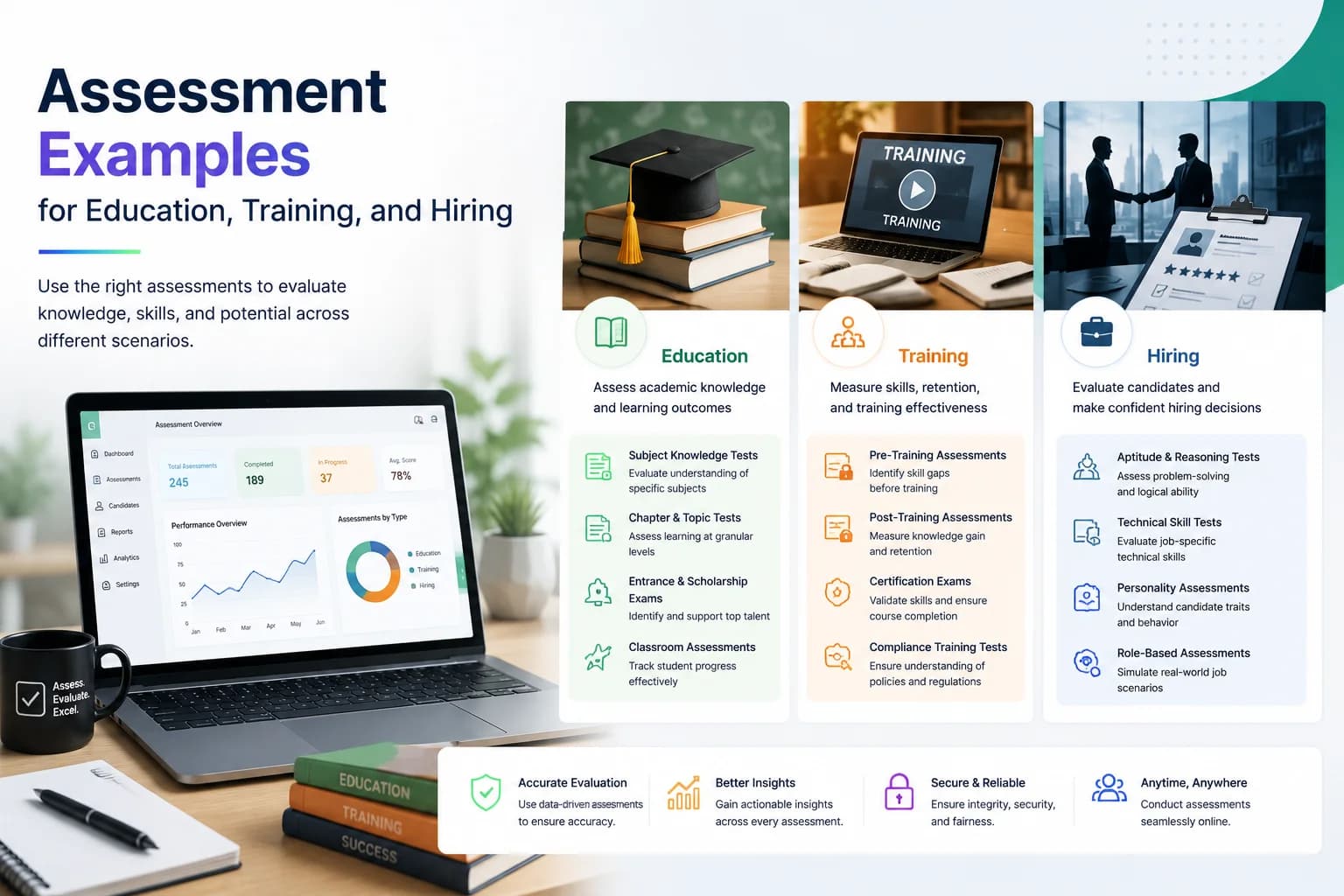
Pre-employment testing works when every question maps directly to the job. Treat tests as evidence to inform decisions, not as verdicts. The strongest pre-employment testing programmes are built on three pillars: job relevance (the test measures what actually matters for day-one performance), consistency (every candidate for the role gets the same experience), and appropriate use (scores are one input alongside interviews and references, not the final word). This guide covers how to design, deliver, and use pre-employment tests in a way that is fair to candidates and useful to hiring teams.
Resumes tell you what someone has done. Pre-employment tests tell you what someone can do right now, at a consistent standard, without the confounds of brand name institutions or polished CV language. The goal is to surface candidates who might otherwise be filtered out by resume screening biases and to eliminate candidates who look good on paper but lack the foundational knowledge the role requires.
A pre-employment test that systematically disadvantages candidates from certain backgrounds — without that disadvantage being related to genuine job requirements — is both unfair and legally risky in most jurisdictions. The legal standard in employment testing is job-relatedness: the test must measure knowledge or abilities that matter for the specific role. Cognitive aptitude tests and domain knowledge tests generally meet this standard when designed carefully.
A job analysis identifies what knowledge, skills, and abilities a person needs to perform the job competently from day one. It is the foundation of a defensible test. Without it, you are writing questions based on what the question-writer knows, not what the role requires. A simple job analysis: interview the hiring manager and two high performers in the role, ask what they need to know on day one and what they look up regularly, then build questions from that input.
Candidates who have a poor testing experience — clunky interface, unclear instructions, no confirmation of submission — share those experiences. For mid-career candidates with options, a frustrating assessment is grounds to withdraw. The test is the first real product interaction candidates have with your organisation. It should be as smooth as a consumer app: clear instructions, mobile-friendly, and immediate confirmation on submit.
The invite email should contain everything a candidate needs without requiring them to contact you. Subject: "[Company] — Next Step: [Role] Knowledge Assessment". Body: We would like to invite you to complete a short assessment as part of our hiring process for the [Role] position. The assessment covers [topic areas] and takes approximately [X] minutes. Your access window is [date] between [start time] and [end time]. Click your personal link below to begin any time within that window. Contact [name] at [email/WhatsApp] if you experience any technical issues during the assessment.
Set your pass mark before you see the scores from your first real candidate cohort. Base it on a pilot: have current employees in the role take the assessment and note where the line between clearly qualified and clearly underqualified falls. After running two to three real cohorts, you will have data to validate or revise that threshold. A data-driven cutoff is more defensible and more accurate than an intuitive guess.
Adverse impact occurs when a selection method disproportionately excludes candidates from a protected group at a rate significantly greater than the majority group. To check for this, compare pass rates across demographic groups after each hiring cycle. If a significant gap exists, investigate whether specific questions are driving the disparity and whether those questions are genuinely job-relevant. One practical approach is score banding: treating candidates within a small score range (say, 68–75%) as statistically equivalent and selecting among them on other criteria rather than treating every point as a decisive difference.
Pre-employment test scores are a threshold filter, not a ranking mechanism for finalists. Use the test to eliminate candidates below a minimum competency threshold. Use structured interviews and work samples to distinguish among those who pass. The highest scorer on a domain knowledge test is not necessarily the best hire — judgment, communication, and collaboration matter too.
For every hiring decision, document why a candidate advanced or was declined. For pre-employment tests, the documentation is simple: which test was administered, what the cutoff was, and what the candidate scored. This documentation protects the organisation if a hiring decision is challenged and enables analysis of which tests actually predict performance over time.
Send the test link via email from your dashboard, include all instructions in the email, and ensure the platform works on mobile without requiring any app download or account creation. EasyEvaluate's email invite feature covers this: candidates receive a personal link, click once, read the instructions on screen, and begin. No registration, no friction. For high-stakes lateral hires, consider adding AI proctoring as a $5/mo add-on to create a reviewable record of the attempt.