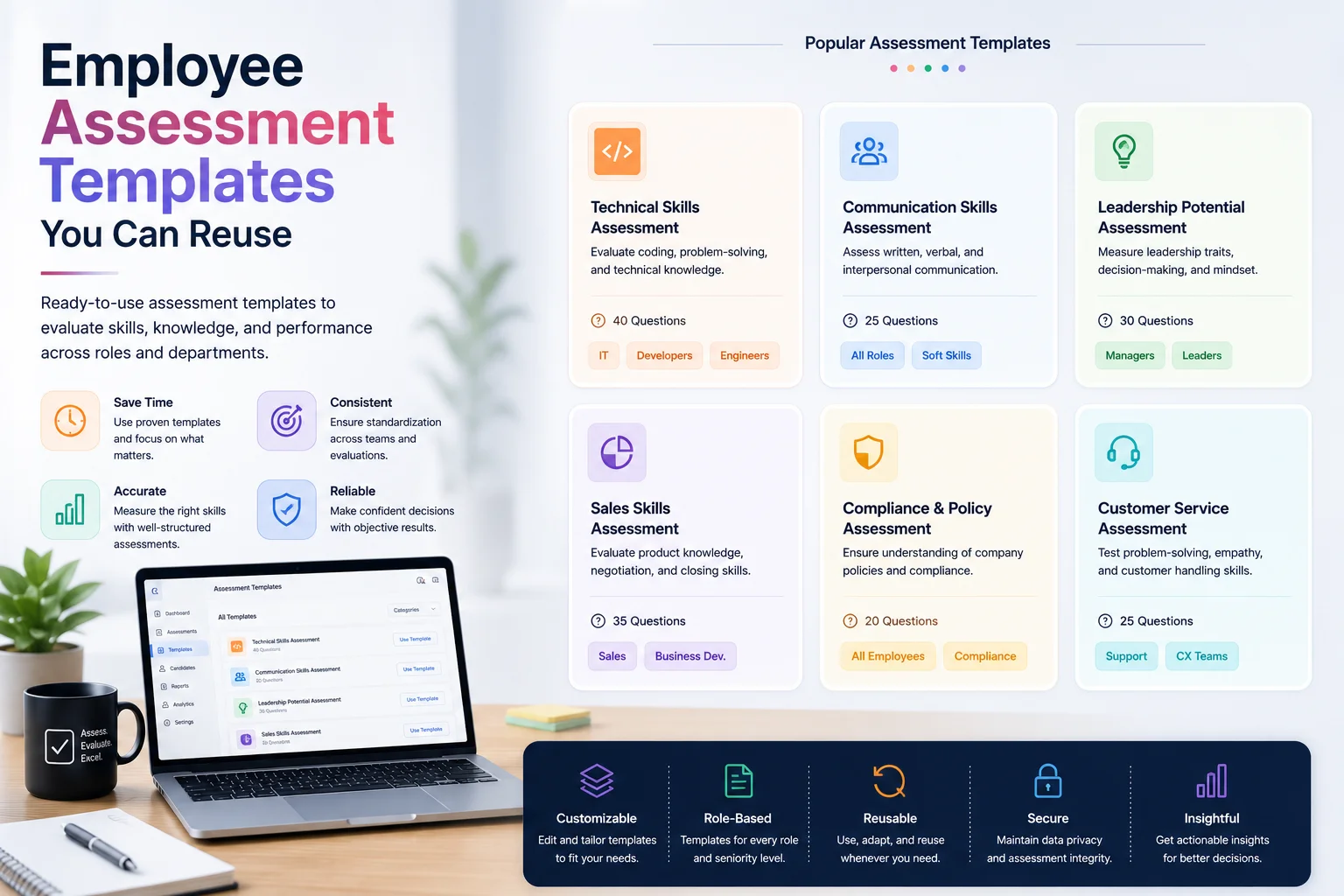
Assessment examples help teams stop reinventing the wheel. Most knowledge checks, skill screens, and competency tests follow a small number of structural patterns — once you recognise the pattern, you can adapt it to your context in minutes rather than building from scratch. This guide covers practical assessment examples across education, corporate training, and recruitment, with notes on the format choices and delivery decisions that make each one work. All of these can be built on an online assessment platform like EasyEvaluate without any technical setup.
A useful assessment example is not just a list of questions — it is a structural template that tells you the purpose, the format, the timing, the pass criteria, and how results will be used. Without those decisions documented, you will rebuild them from scratch every cycle, and results from different sessions will not be comparable.
Five to ten MCQs covering the key points from a single lecture. Questions map directly to learning objectives: one question per concept. Duration: five to eight minutes. Results shown immediately so students get instant feedback. No negative marking — the goal is diagnostic, not punitive. Instructors review the per-question accuracy report to identify which concepts need reteaching before moving on.
Twenty to thirty questions covering a full chapter or unit. Mix difficulty: eight easy recall questions, fourteen medium application questions, and six harder analysis questions. Duration: 30–40 minutes. Shuffle enabled. Pass mark set at 60%. Results held until the window closes, then released to the class.
Mirrors the format of a board exam or university internal as closely as possible. Full duration (90–180 minutes), same question count and type distribution as the real paper, all integrity controls enabled. Purpose: acclimatise students to exam conditions and surface weak topics. Conduct at least two mocks before any high-stakes exam. Share per-question analytics so students know where to focus revision.
Annual or bi-annual test after mandatory compliance training (GDPR, safety, code of conduct). Short — 10 to 15 questions, 15 minutes maximum. Pass mark of 90% reflects the high stakes of compliance failures. Export scores as PDF or CSV for audit evidence. Track non-completions separately as a compliance gap.
Run the same assessment before and after a training programme. Compare individual and cohort scores. The improvement delta tells you more than the final score alone — a candidate who scored 30% before and 70% after a training improved more than one who started at 65% and ended at 70%. Use this structure for upskilling programmes where growth, not just attainment, matters.
Role-specific knowledge test delivered before the first interview. For a data analyst role: SQL, statistics, and data interpretation questions. Duration: 30 minutes, 25 questions. Candidates who score below 60% are declined at this stage without consuming interviewer time. Questions should be updated every two hiring cycles to prevent answer sharing.
Present realistic work scenarios as question stems. Example: "A customer says they received the wrong product and demands an immediate replacement. Your store's policy requires a manager approval for replacements. What do you do?" with four plausible options. Tests judgment and policy knowledge simultaneously. Works for support, sales, and service roles where soft skills and process adherence both matter.
The most underused part of online assessment is the feedback loop back to candidates. For formative education assessments, showing candidates which questions they got wrong and what the correct answer is — immediately after submission — turns an assessment into a learning event. For corporate training checks, a message pointing to the specific module section a candidate should re-read reduces support requests and improves retake scores.
For hiring screens, the industry norm is to decline unsuccessful candidates without detailed score breakdowns, for legal reasons. But providing a timeline ("you will hear back within five business days") and a human tone in the communication improves employer brand perception even for candidates who did not advance.
The same structural template often translates directly between contexts with only the questions changing. A 20-question, 25-minute, shuffle-enabled paper with a 70% pass mark works for a post-training knowledge check, a pre-interview domain screen, and a chapter test — the only difference is the question content and the decision the score supports. Recognising this saves significant design time when you need to build a new assessment type quickly.
Once you have run an assessment type twice, template it. Save the question structure, timing rules, pass mark, and communication template. Over two to three cycles, you build an assessment library that any team member can use without reinventing the process. EasyEvaluate's question bank makes this straightforward — tag questions by topic, difficulty, and use case, then assemble new papers from the bank in minutes.