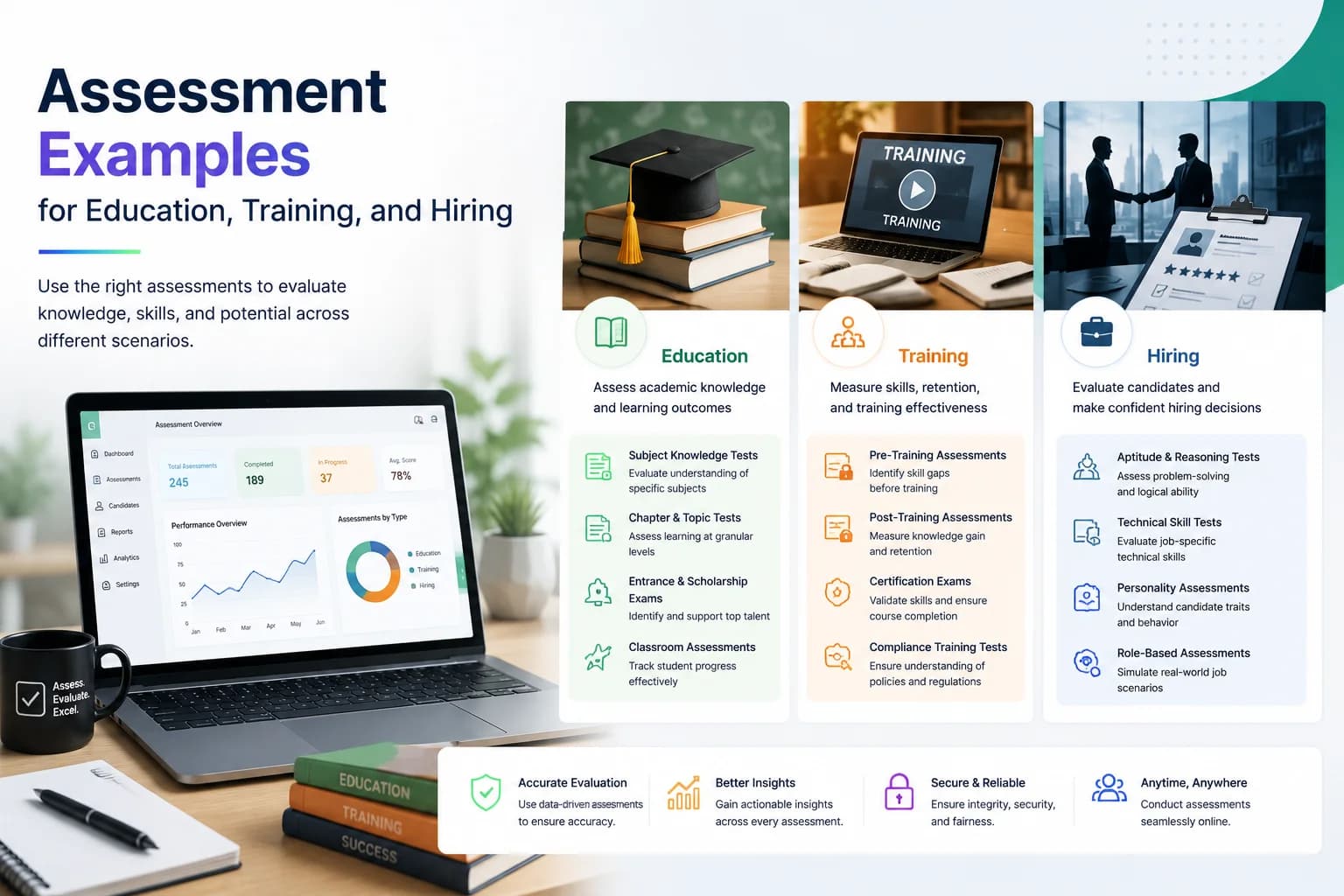
Employee assessment templates save L&D and HR teams from building every test from scratch. The same structural decisions repeat across most employee assessments — question count, timing, pass mark, retake policy, and how results connect to a decision or development action. Documenting those decisions once and reusing the structure across roles and departments is how small L&D teams scale their assessment programmes. This guide covers the four most common employee assessment templates, the settings for each, and how to adapt them to your organisation's context.
When every assessment is built from scratch, quality is inconsistent. One manager writes 30 thoughtful questions; another writes 5 rushed ones. One team sets a 70% pass mark; another sets 95% for the same type of content. Templates standardise the structure so that the only thing that varies between assessments is the specific questions — everything else (timing, pass criteria, retake policy, export format) is decided once and inherited.
Purpose: confirm that new joiners have absorbed the essential information from their first week of onboarding before they begin independent work. This is not a punitive exam — it is a knowledge safety net. Questions cover company tools, policies, team processes, and role-specific procedures.
Purpose: confirm annual or bi-annual compliance with mandatory regulatory training (data privacy, health and safety, anti-bribery, code of conduct). Results are evidence for audits, so the export and record-keeping requirements are stricter than other assessment types.
Purpose: measure skill development at the midpoint and end of an upskilling programme. Run the same assessment before training begins (baseline) and after it ends (post). The comparison, not just the final score, tells you whether the training worked. This template is especially useful for technical skills courses where baseline varies widely across participants.
Purpose: confirm that an employee meets the knowledge standard required to perform a role independently, handle a process without supervision, or receive a certification. Higher stakes than other templates — results may determine pay grade, promotion eligibility, or whether someone can perform certain tasks.
Not all employee assessment is MCQ-based. For soft skills, leadership behaviours, and project management competencies, a structured manager-rated review works better. The template: a scoring rubric with four to six competencies, a three-to-five point scale per competency, and mandatory evidence for any score at the extremes. Run annually or at promotion checkpoints.
Onboarding check questions should reference specific company tools, internal process names, and policy numbers — generic knowledge questions test nothing the organisation needs to know. Compliance questions should be based directly on the training content and reference the specific regulation or policy section, not general industry knowledge. Upskilling questions should progress in difficulty across the question set so the assessment discriminates between partial and full mastery.
Non-completion is a bigger problem than failure for most employee assessment types. An employee who does not take the compliance check is a more serious compliance gap than one who takes it and scores 80%. Build a non-completion process: automated reminders at day three and day seven, escalation to line manager at day ten, documentation of persistent non-completions for HR records. EasyEvaluate's dashboard shows who has and has not started, making it easy to identify and follow up on non-completers.
The structure stays constant — question count, timing, pass mark, retake policy. The questions change per role family. A compliance check for finance covers different regulations than one for engineering. An upskilling checkpoint for sales covers negotiation and product knowledge; for data teams, it covers analysis tools and methodology. Build one template per type, then create role-specific question sets inside each template.
The most useful employee assessments feed directly into existing performance management cycles rather than existing as parallel standalone events. Map each template to a trigger in your HR process: onboarding check runs at end of week one, compliance refresher runs at annual renewal, upskilling checkpoint runs at programme end, certification assessment runs at promotion nomination. When the assessment result is required input to a manager conversation that is already scheduled, completion rates improve significantly.
EasyEvaluate's question bank lets you tag and store questions by topic, role, and difficulty. Once your question bank has depth, assembling a new employee assessment takes minutes — pick the template structure, draw questions from the bank by tag, set the access window, and send invites from the dashboard. The free core platform handles all four template types; enable AI proctoring as a $5/mo add-on for certification exams that require monitoring.