A competency assessment framework turns vague "good at the job" opinions into repeatable, evidence-based checks. The goal is not bureaucratic complexity — it is to answer three questions clearly: what does good look like for this role, how do we know someone meets that standard, and when do we check again. Most organisations overcomplicate their frameworks until managers stop using them. This guide gives you the simplest viable framework structure that still holds up when you need to make development, promotion, or hiring decisions.
The failure pattern is consistent: HR builds a fifty-competency framework with elaborate behavioural indicators at seven levels. Managers look at it twice and then file it away. Real competency assessment requires frameworks that are usable without a manual — short enough to hold in working memory, concrete enough to apply without interpretation, and connected to decisions managers actually make.
Start with the job, not the framework. Ask: what does someone need to know, be able to do, and how do they need to behave to succeed in this role? Start with 5–8 competencies maximum. More than that and the framework becomes a performance review form rather than a usable guide. Competencies should be specific enough that two managers would agree on whether someone demonstrates them.
Three levels are usually enough: Basic (can perform with guidance), Proficient (can perform independently), and Advanced (can perform and teach or troubleshoot edge cases). Define each level with a concrete statement for each competency. The test: a manager should be able to read the level description and decide within 30 seconds which level an employee is at based on what they have observed.
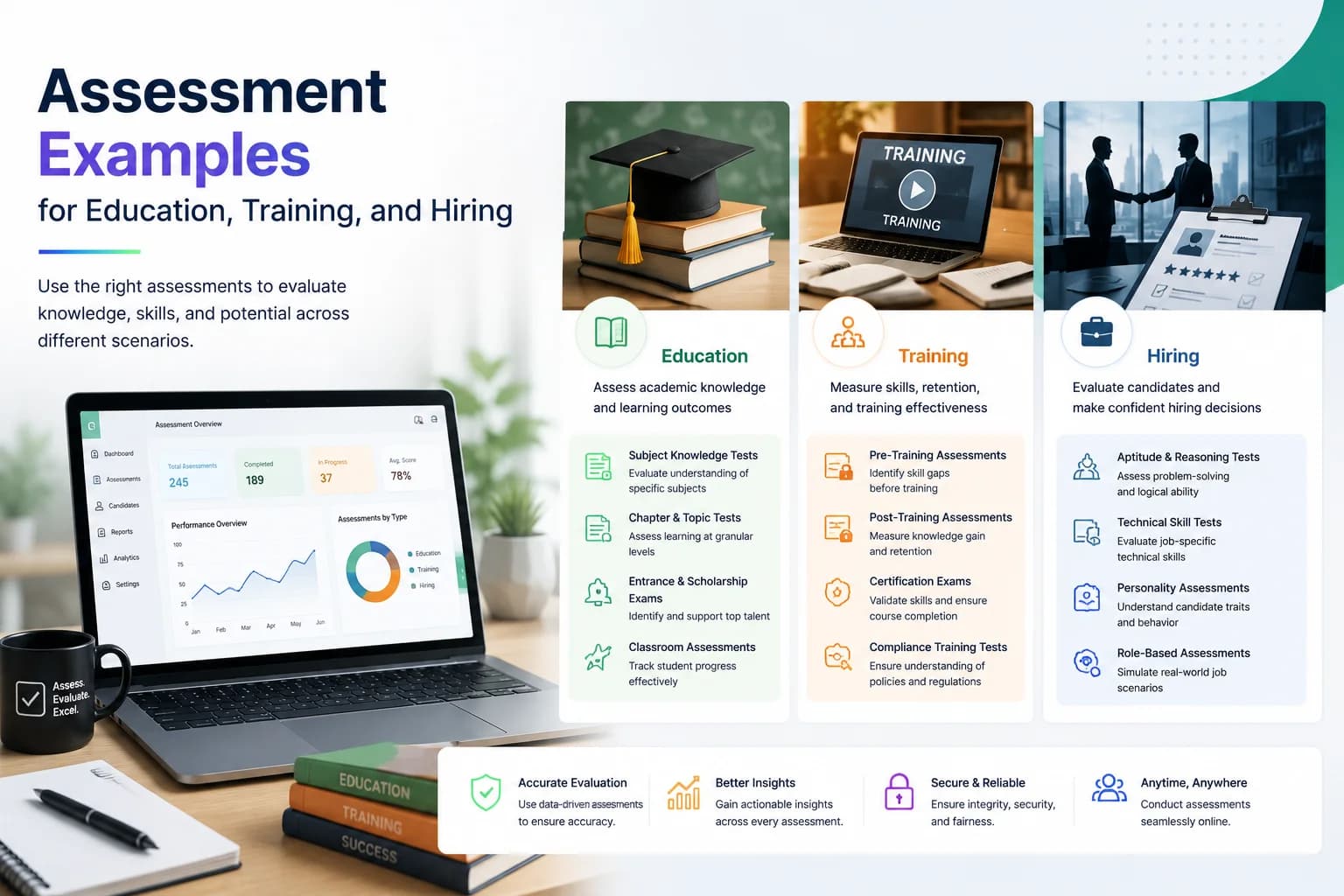
Knowledge and procedure competencies map cleanly to online tests: create a 20–30 question assessment covering the competency domain, set a pass mark per level, and the evidence is the score. Behavioural competencies — communication, collaboration, judgment — require structured observation, peer feedback, or scenario-based interview questions. Do not force everything into MCQs. An online exam cannot tell you whether someone communicates clearly under pressure.
Competencies do not need to be assessed at every performance cycle for every employee. A useful default: reassess all competencies annually, or when an employee transitions roles or levels. For fast-changing technical domains (data tools, regulatory content), reduce the interval to six months for the relevant competencies. For stable competencies (basic writing, company values), annual is sufficient.
Competency 1 — SQL proficiency. Basic: can write SELECT statements with filters and joins. Proficient: writes optimised multi-table queries independently. Advanced: reviews and troubleshoots complex queries from the team. Evidence: online SQL knowledge test (Basic requires 60%, Proficient requires 80%) plus observed query output quality. Competency 2 — Data communication. Basic: can explain a chart to a non-technical colleague. Proficient: presents findings clearly in stakeholder meetings. Advanced: designs dashboard layouts for business users. Evidence: manager observation during presentations plus peer feedback.
Running this framework takes one 25-minute online test per technical competency per cycle, plus one structured conversation with the manager. For a cohort of twenty analysts, the whole cycle takes under two days of elapsed time and produces an evidence-backed skills map for every employee. That is the level of usability a framework needs to survive beyond its first quarter.
Managers resist competency frameworks for two reasons: they seem like extra work, and they feel like HR surveillance. Both concerns are addressed by design choices. Keep the framework short (five to seven competencies, three levels). Make the evidence instruments fast — a 20-question online test and a 30-minute structured conversation, not a two-hour annual review form. Involve managers in defining the competencies rather than presenting them with a finished framework. People use what they helped build.
A framework built once and never revised becomes irrelevant within two to three years. Roles evolve, technology changes, and business priorities shift. Schedule an annual framework review: does each competency still reflect what the role requires? Have any competencies become table stakes (so basic that everyone has them, making them useless for differentiation)? Are there new technical or domain competencies that should be added as the business evolves?
Online assessments handle the knowledge and procedural competency evidence efficiently. For each knowledge competency, build a question bank of 40–60 items covering the domain. Draw a randomised 25-question paper per assessment cycle. This prevents question memorisation and ensures the assessment remains valid over multiple cycles. EasyEvaluate's free platform supports this workflow without any per-attempt charges — you can reassess a 200-person team annually without worrying about assessment costs.