Online exams create a fundamental tension: you want candidates anywhere in the world to be able to sit your test, but "anywhere" also means unsupervised. You cannot guarantee a zero-cheating environment any more than an in-person exam can. What you can do is raise the cost of cheating high enough that most candidates do not bother, and create an audit trail so that the small number who do can be identified. This guide covers every practical layer of anti-cheating controls available in secure online exam software like EasyEvaluate, and explains when to use each one.
No single feature stops cheating. A fullscreen lock does not stop a second phone. AI proctoring does not stop a candidate who memorized answers in advance from a leaked paper. Shuffle alone does not stop two candidates who share their individual question orders after the fact. Integrity comes from combining controls that target different threat vectors simultaneously. Think of it as defense in depth: each layer catches a different class of attempt, and the combination makes the whole exam far more resilient than any single feature would.
Time pressure is your cheapest and most effective anti-cheating tool. A well-timed exam leaves no slack for searching the web or waiting for a friend to send answers. The goal is not to make the exam a race — it is to ensure that a candidate who knows the material can finish comfortably while someone who is relying on external help cannot.
Auto-submit on timeout enforces the rule uniformly. Without it, candidates who stay logged in past the deadline gain extra time that others do not. Set the timer, enable auto-submit, and the rule applies identically to every candidate regardless of where they are sitting.
For high-difficulty exams, calibrate timing carefully. Too tight and you are testing speed rather than knowledge; too loose and you hand cheaters free search time. A useful heuristic: run through the paper yourself at a comfortable pace, then add 30–40 percent for slower readers and device variation.
Shuffling is the most practical defense against cooperative cheating in settings where multiple candidates sit the same exam — classroom labs, campus recruitment halls, or even remote exams where candidates know each other. When each person sees a different question order, sharing answers by question number no longer works. When options within each question are also shuffled, calling out "B" or "3" provides no useful information.
EasyEvaluate applies both question-level and option-level shuffling per login, so even if a candidate refreshes or re-enters, the order changes. The correct answer is stored against content, not position, so grading is unaffected.
Shuffling from a large question bank is more powerful still. If your bank contains 80 questions and each candidate receives 40 drawn randomly, the probability of any two candidates sharing the same paper drops dramatically. Build the bank incrementally over multiple exam cycles and retire questions that appear to have been circulated after reviewing post-exam analytics.
Browser controls raise friction for the most casual form of cheating: switching to another tab to search Google or check shared notes. EasyEvaluate's controls include:
These controls do not stop a candidate using a separate device. They are not designed to. Their value is in removing the easiest path — the quick Ctrl+Tab to a search engine — and creating a deterrent signal that exam integrity is monitored. Candidates who know a tab switch is logged often decide not to bother.
Open exam links — URLs anyone can access without authentication — are one of the biggest integrity holes in online testing. If the link is forwarded to someone outside the intended group, there is no technical barrier to them attempting the exam on behalf of an enrolled candidate.
Restrict the exam to selected attendees only: candidates must log in with a credential that is verified against the attendee list. This prevents link forwarding from turning into proxy attempts. Combine it with a narrow scheduling window — open the exam for two hours on a specific date rather than leaving it available for a week — and the coordination required for impersonation becomes much harder.
Single-device login (blocking a second login while an active session exists) adds another control: the verified candidate cannot share their session with someone else mid-exam.
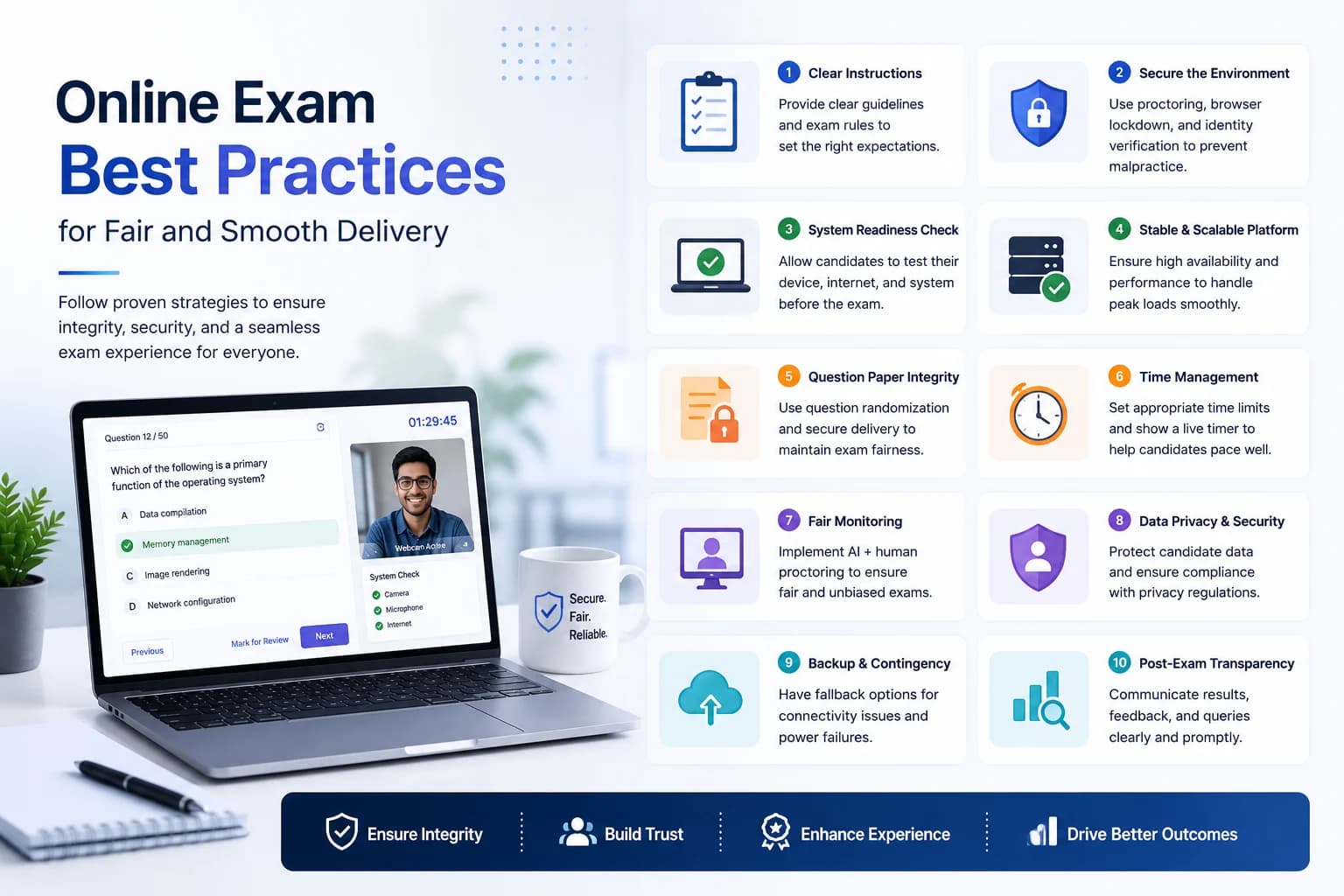
For exams where the consequences of a dishonest result are significant — certifications, entrance exams, competitive recruitment — browser controls and shuffle are not enough on their own. This is where AI proctoring comes in. EasyEvaluate's proctoring add-on ($5/month) uses the candidate's webcam to record the attempt and flags suspicious behavior automatically: face disappearing from frame, multiple faces in view, unusual head movement, or physical materials being consulted.
Recordings are retained for 5 days, giving exam administrators time to review flagged attempts. This is not just a deterrent — it is an audit trail. When a candidate disputes a result or an integrity concern is raised, you have video evidence to review rather than relying on inference.
Practical note: inform candidates in writing before the exam that proctoring is in use and that recordings are retained. This is both legally cleaner and a stronger deterrent than surprise proctoring. Candidates who know they are being recorded are far less likely to attempt anything risky.
No live control catches everything. Post-exam analytics add a statistical layer that can surface patterns invisible during the attempt:
These signals do not constitute proof — they guide manual review. Treat them as investigation triggers, not automatic disqualifications.
Technical controls work best when the paper itself is hard to game. A question bank composed entirely of publicly available MCQs from previous years will be defeated by a candidate who simply memorized the answers in advance — no software fix helps there.
Design questions that require application rather than recall:
The best anti-cheating investment is a question paper where knowing the material genuinely is the path of least resistance. Controls support that; they cannot substitute for it.
Fair assessment is not just about stopping dishonest candidates — it is about reassuring honest ones that their results mean something. Publish a one-page exam policy that explains every control in place and why it exists. When candidates understand that AI proctoring flags are reviewed by a human before any action is taken, they are more comfortable with the process. When they know that results are statistically analyzed, they trust that passing means something.
An explicit policy also protects you. If a candidate raises a complaint about a disqualification, your written policy — which they acknowledged before starting — is the first line of defense.